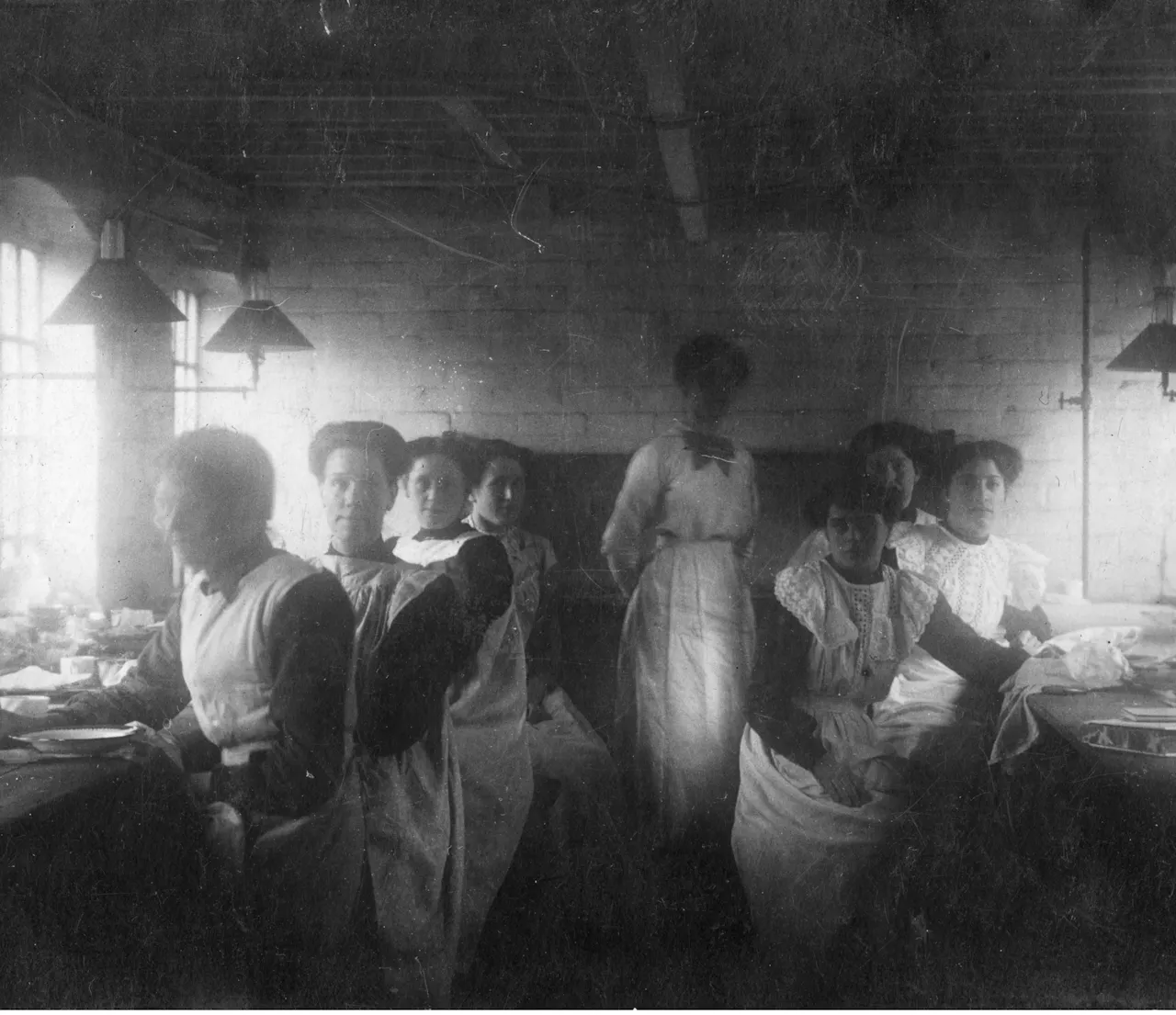
Beyond the famous names: the real lives behind Britain’s war memorials
7-8 minute read
By Ellie Ayton | October 30, 2026

On high streets and village greens across Britain, names are carved into weathered stone. We may recognise some as poets, sportsmen, politicians, or even royalty. But before they became names on memorials, they were people with ambitions and families who watched them leave for war.
You can begin in the same way, with a name from your family, your town or one of the memorials you pass every day.
Because every name deserves to be remembered.
Where the stories begin
A war memorial can be so familiar that it almost disappears into the landscape. Then you stop. The traffic continues, shop doors open and close, but the columns of names have you pause a little longer.
Each name belongs to someone whose absense once changed a household, a circle of friends, and a community.

War memorials unveiled in Glasgow, Galston and Folkestone in 1922, from Illustrated London News, Saturday, 9 December 1922.
Behind the stone were ordinary scenes of parting: families at front doors, loved ones on railway platforms, final waves disappearing into the distance. For many, life divided at that moment into before and after.
The son who never came home
John Kipling was the only son of the poet Rudyard Kipling and his wife Carrie of Bateman’s in Burwash, Sussex. At 18, he was serving as a lieutenant with the 2nd Battalion Irish Guards. On 27 September 1915, he disappeared into the chaos at the Battle of Loos.
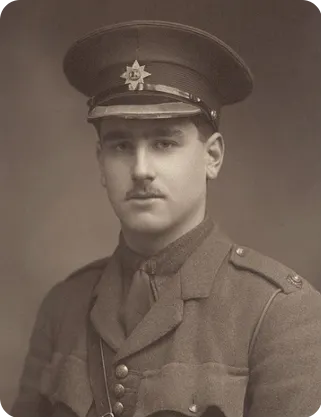
John Kipling.
No-one knew what had happened to John. Eventually came the news no parent wanted to hear, preserved in newspaper articles that reduced the family’s anguish to three stark words: “Missing, believed killed.”
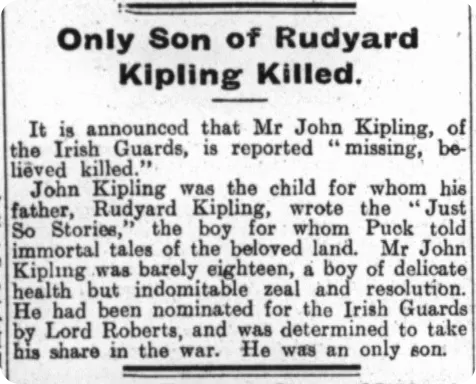
Announcement of John Kipling’s death, in Dundee Weekly News, Saturday, 9 October 1915.
John’s name was later added to the Burwash war memorial. His body was never found, leaving his family with a name in stone but no grave to visit.
A poet, a soldier, a son
Today, Wilfred Owen is remembered as one of the defining poets of the First World War. By delving deeper into his surviving records, we find the man behind that reputation: a soldier of the Manchester Regiment who experienced neurasthenia, or chronic fatigue and exhaustion, in 1917 and returned to the front.
He was killed on 4 November 1918, just one week before the Armistice.
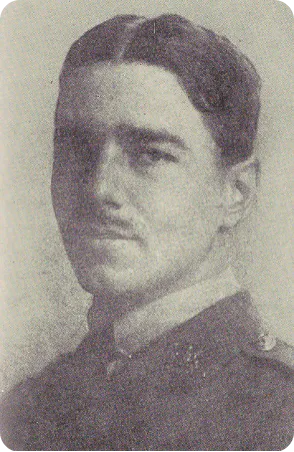
Poet Wilfred Owen, pictured in The Scots Magazine, Monday, 1 January 1940.
He lies at Ors Communal Cemetery in France, while memorials at Abbey Parish and in Shrewsbury carry his name nearer home. That distance tells its own story.
A life rooted in one community ended hundreds of miles away. Those who buried Owen in France and those who mourned him at home became part of the same act of remembrance: keeping a connection to someone who did not return.

Wilfred was treated for neurasthenia (chronic fatigue and exhaustion) in 1917, according to First World War Soldiers’ Medical Records. View the full record here.
Britain’s war memorials still hold those connections today.
The careers that war cut short
Other names reveal futures already taking shape before war broke across them.
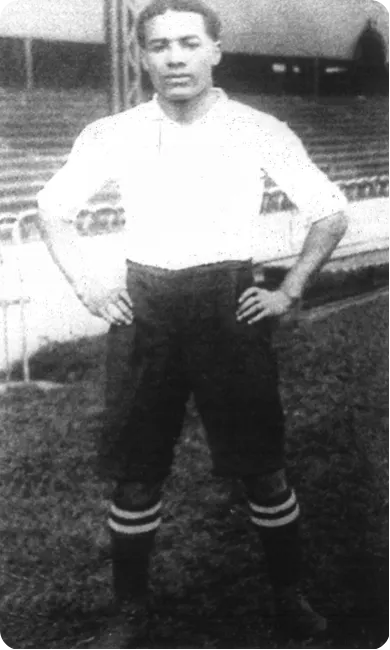
Walter Tull in his footballing days, pictured in the Maidstone Telegraph, Friday, 14 March 1997.
Walter Daniel John Tull built a career as a professional footballer before he went to war. He served until 25 March 1918, when he was killed in action during the First Battle of Bapaume. With no known grave, he’s now commemorated on the Arras Memorial.
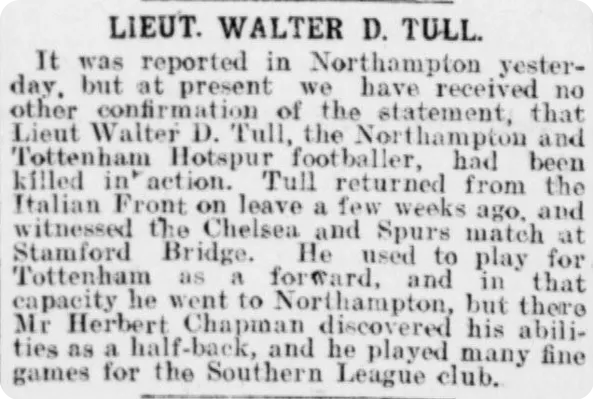
Walter’s death announced in Sporting Life, Friday, 5 April 1918.
Ronnie Poulton was an England rugby captain. He died on 6 May 1915, and his name appears at Hyde Park Corner in Belgium and on the Rugby School Chapel Memorial, connecting the battlefield with the places that shaped him.
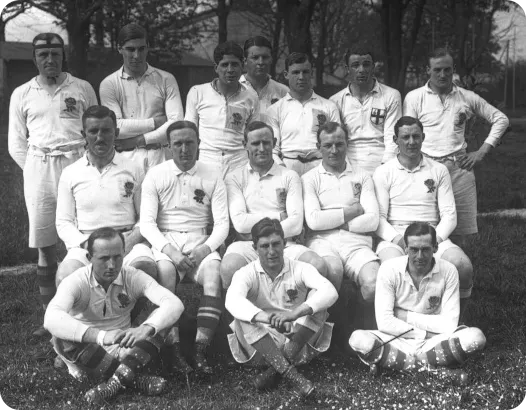
Ronnie Poulton (centre), captain of the England team against France on 13 April 1914.
Another rugby player whose future was cut short was Bristol forward James Edward ‘Jimmy’ Friend. Before the war, he worked in the city’s shipyards and had been a Redcliff School choirboy: a life of work, sport and community. Wounded in 1915, he recovered and returned to the front, only to be killed on 3 September 1916, aged 22.
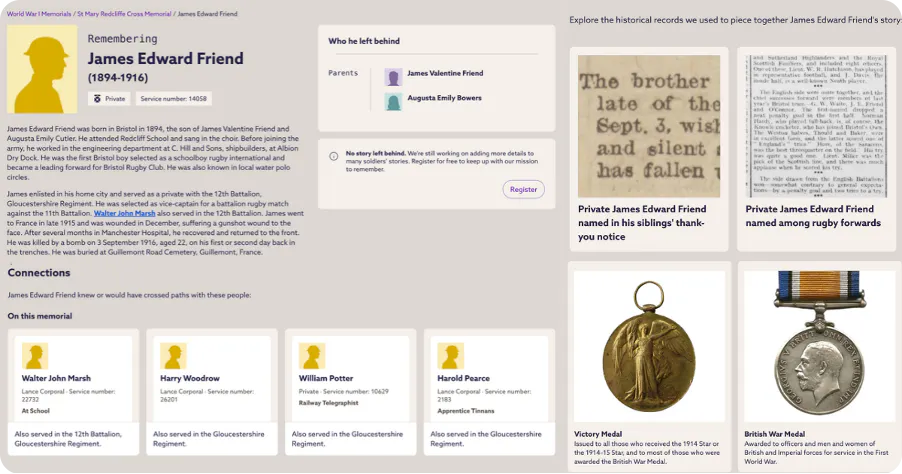
Jimmy Friend's Military Lives page.
We can breathe life back into Jimmy’s story using Military Lives: we discover his parents, more about his rugby career, and those he served alongside.
Privilege couldn’t protect a family from loss
Raymond Asquith was born into one of Britain’s most prominent families, the son of Prime Minister H. H. Asquith. Yet when he joined the 3rd Battalion Grenadier Guards, his public position offered no shelter from the dangers faced by thousands of other families.
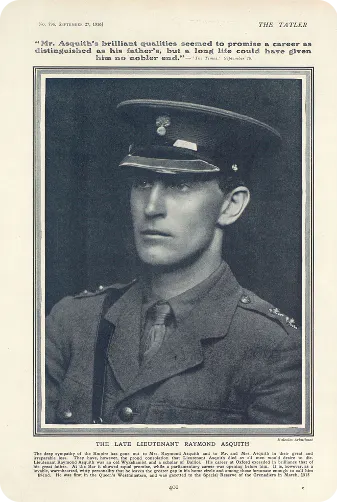
Raymond, remembered in The Tatler, Wednesday, 27 September 1916.
On 15 September 1916, during the Battle of Flers-Courcelette, Raymond was shot in the chest. He was buried at Guillemont Road Cemetery; closer to home, his name was placed on a memorial in Mells, Somerset. His father’s position made the family exceptional, but their grief did not. It was the same grief felt by thousands of families across the country.
Even royalty couldn’t escape it. Prince Maurice of Battenberg, cousin to King George V and grandson of Queen Victoria, served as a second lieutenant in the King’s Royal Rifle Corps.

Maurice’s grave with its early marker, in Daily Mirror, Monday, 23 November 1914.
He was killed on a ridge at Zonnebeke on 27 October 1914.
They died at the same battle, on the same day
Hedd Wyn was the bardic name of Ellis Humphrey Evans, a Welsh poet killed on 31 July 1917, the first day of Passchendaele. At that year’s National Eisteddfod, he was awarded the bard’s chair after his death. His name was called across the gathering, but no poet rose to claim it. Instead, a black sheet was drawn over the empty chair.

Ellis Humphrey Evans (Hedd Wyn).
His bardic name means “blessed peace” in Welsh. A non-conformist pacifist, Ellis was conscripted so that his younger brother did not have to go. Like Wilfred Owen, he wrote after war began; in Rhyfel, “War”, the violence abroad casts its shadow across ordinary homes:
"Pan deimlodd fyned ymaith Dduw
Cyfododd gledd i ladd ei frawd;
Mae sŵn yr ymladd ar ein clyw,
A'i gysgod ar fythynnod tlawd."
"Man raised his sword, once God had gone,
To slay his brother, and the roar
Of battlefields now casts upon
Our homes the shadow of the war."
At the same battle, on the same day, another poet was killed. Francis Ledwidge, the eighth of nine children in a poor Irish family, had served at Gallipoli and on the Western Front.

Francis Ledwidge.
On 31 July 1917, he paused from his work building a road in pouring rain. He had a cup of tea in his hand when a shell exploded beside him.
Most of the dead have no biography or familiar photograph to keep them before us. Their stories survive in fragments, waiting for someone to follow a name into the records and bring the person back into view.
To remember them.
Begin with a memorial you know
This Remembrance, pause somewhere familiar.

Find a local war memorial and choose one name. Follow it through the surviving records: into a household, a regiment, a newspaper report or a community’s grief. Uncover the stories that connected the men whose names sit side by side.
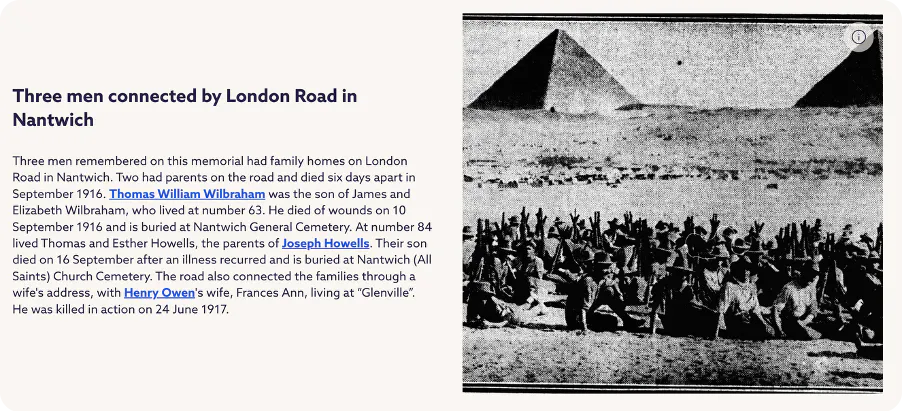
You may not recover every part of the story, but even a few details can turn an inscription into someone you can begin to know.
The famous names are only a handful among many. Look closely at the memorial in your own town and you may find a life that has been waiting to be remembered.
Somewhere among those stories, you may also find a connection to your own.