What we discovered about the First World War women remembered on one extraordinary memorial
7-8 minute read
By Ellie Ayton | November 2, 2026

Behind every name carved in stone is a story. Yet women are far less visible on First World War memorials, despite the many ways they served, worked and lost their lives during the conflict. Here are their stories.
Thankfully, one remarkable memorial at York Minster preserves more than 1,400 of their names. But until we look closer, they’re just names.
Who were the women who died during the Great War? What are their stories?
Where are the women in First World War history?
Think of a First World War memorial and you'll probably picture weathered stone in a town square or churchyard, carved with rows of men's names.
Women's names are much harder to find, largely because women didn’t serve in the British armed forces in the same capacity as men. But their absence from many memorials can obscure the scale and variety of their contributions.
Women nursed wounded servicemen, made munitions, worked in transport, and served at sea. They joined organisations including the Women's Royal Naval Service, Women's Royal Air Force, the Women’s Land Army, and Red Cross. Their work took place in Britain and thousands of miles from home, and some died during active service. Their stories form part of the history of the First World War, even if we don't encounter their names as often.
One place that has preserved these names is York Minster. Within the vast medieval cathedral, the Women of the Empire screen commemorates more than 1,400 women who died during the war or because of it, from nurses and munitions workers to Merchant Navy stewardesses. They came from all over the former British Empire.
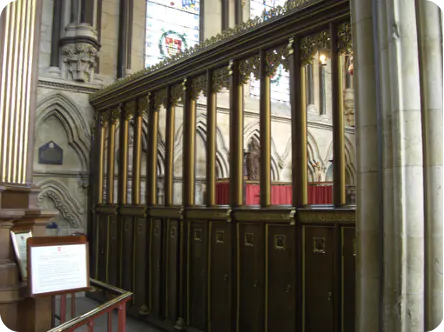
The Women of the Empire screen in York Minster, in the Military Service Memorial Collection.
The names are fixed in place, but the lives behind them reached into homes, hospitals, factories and ships. What happens when we look at the records behind them?
The telephonist sisters buried together
The memorial brings together the stories of sisters Dorothy Marjorie and Harriet Hawkesworth Drewry of Grimsby, a busy fishing port shaped by the movement of ships, crews and news from the sea. Both served as telephonists in the Women’s Royal Naval Service (WRNS), handling communications in a role that demanded accuracy and concentration.

Harriet and Dorothy with their family on the 1901 Census.
Harriet died of disease at sea in 1918, while Dorothy died in 1920. They lie side by side in the same Commonwealth War Graves Commission grave. Dorothy had joined the WRNS just months before her sister’s death.
The nurse who survived the Britannic’s sinking
Caroline Amelia Robinette was born in Piltown, County Kilkenny in 1882. By 1911, she lived in London and was working as a surgical nurse.
During the war, Caroline served aboard HMHS Britannic in the Queen Alexandra’s Imperial Military Nursing Service. The ship struck a mine and sank in the Aegean Sea in November 1916. Luckily, Caroline survived the disaster. Then in 1917 at Buckingham Palace, the King awarded her the Royal Red Cross, Second Class, for her outstanding nursing service.
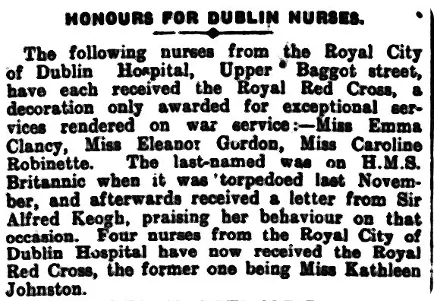
Caroline is awarded a Royal Red Cross decoration, in Weekly Irish Times, Saturday, 17 February 1917.
Shortly afterwards, Staff Nurse Caroline died of influenza and pleurisy on 30 March 1917, aged just 41. Her name alone tells us none of this. By following Caroline through census records, newspapers and other historical sources, a much fuller picture emerges: where she came from, the career she built and what she experienced during the war.
From nursemaid to the Women's Royal Air Force
The records reveal a very different life behind the name of Netta Ellen Broad.
In the 1911 Census, Netta was 14, living with her parents and working as a nursemaid. Her father was a builder's labourer and her mother a domestic charwoman. It was a working household in which wages depended on long hours and practical labour.
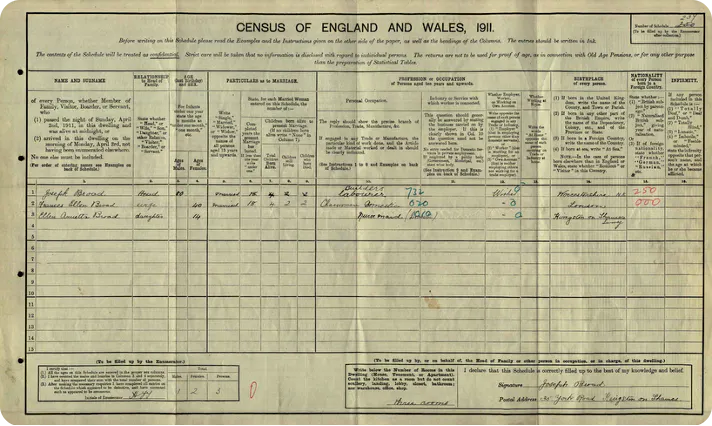
Netta and her parents on the 1911 Census.
Within a few years, war had changed the course of Netta's life. She joined the Women's Royal Air Force and became part of No. 1 Motor Transport Repair Depot. Women like Netta undertook skilled technical work, driving vehicles and maintaining aircraft in busy depots where the sounds of engines, tools and machinery filled the workshops.
Netta died from war-related pneumonia on 24 February 1919, aged only 22 – just three months after the Armistice.
Serving thousands of miles from home
Delving deeper into the names on the memorial reveals just how far women's wartime service could take them: across crowded sea routes, into military hospitals and to unfamiliar ports thousands of miles from home.
Mabel Edith Blencowe’s story led her overseas. Born in Oxford in 1880 and the daughter of a master baker, she served in France during the war as a nurse in Queen Alexandra’s Imperial Military Nursing Service. She died on active service from cerebral meningitis at the 7th General Hospital in Saint-Omer on 10 March 1917, aged 36.
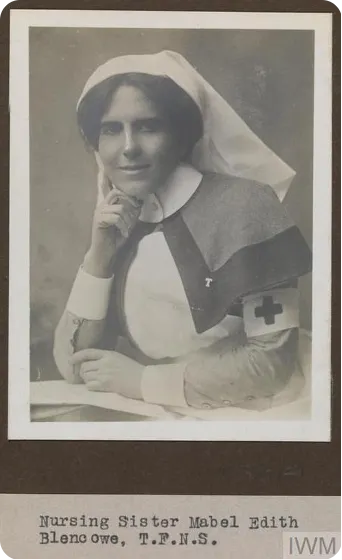
Mabel Blencowe, Lives of the First World War, IWM.
The hospital and former monastery where Mabel died was likely where she also treated sick and wounded soldiers from the front lines. A report in the Oxford Times said:
"She was always cheerful and bright, no matter how tired she felt, and her first interest and care was for the comfort and well-being of her patients."
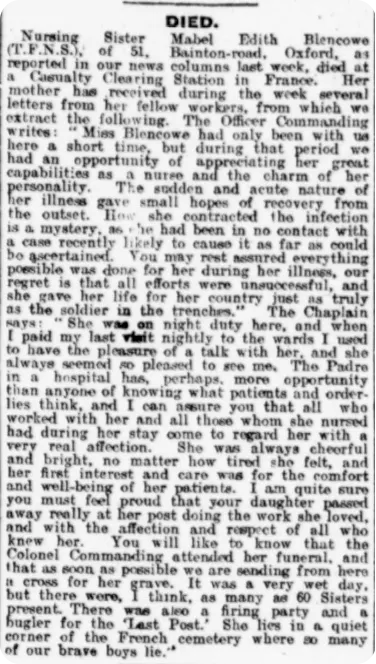
Mabel’s death reported in the Oxford Times, Saturday, 24 March 1917.
Narelle Hobbes was born in Australia. She volunteered for war service as a nursing sister in the same organisation as Mabel, and died on 5 October 1918 while aboard a hospital ship returning to Australia. She was buried at sea.
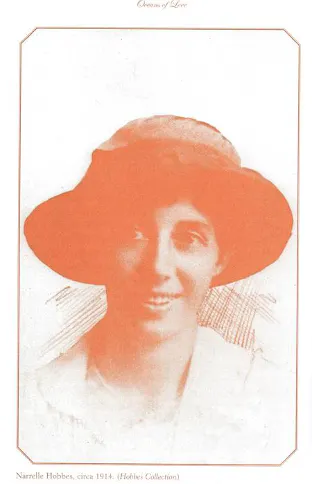
Narelle Hobbes, Lives of the First World War, IWM.
Florence May Faithfull was born in India and served with the Voluntary Aid Detachment during the war.
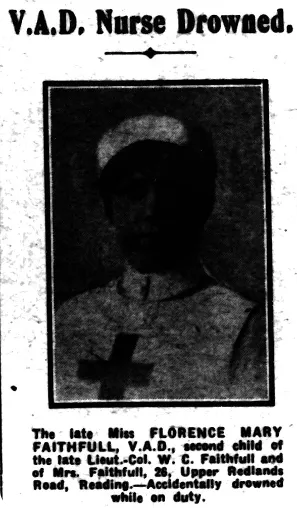
Announcement of Florence’s death in the Reading Standard, Saturday, 16 February 1918.
On 15 January 1918, she was among nursing staff from the 65th General Hospital travelling by motor launch near Basra, Iraq. After an afternoon visit, they began the return journey shortly after sunset. In the fading light, the launch collided with a steam tug. Four members of the nursing staff lost their lives in the tragedy.
Mary Elizabeth Oliphant also served at sea, working as a stewardess in the Merchant Navy. Born in Maryport, Cumberland, she was the widow of William John Oliphant.

News of the sinking, printed in the Liverpool Echo, Saturday, 14 September 1918.
On 9 September 1918, Mary was presumed drowned when the British-Canadian transatlantic liner SS Missanabie was torpedoed in the Irish Sea by the German submarine SM UB-87 while travelling from Liverpool to New York. The ship was part of a busy Atlantic route carrying civilian and military passengers; 45 people died in the attack.
The dangers of war work at home
Some of the women commemorated at York Minster didn't have to travel overseas to face the dangers created by war.
Eliza Jane Paragreen worked at the Rudge-Whitworth works in Coventry, amid the noise, oil and constant movement of wartime production. She operated a spoke-heading machine for the Ministry of Munitions.

The inquest into Eliza’s death, reported in the Coventry Evening Telegraph, Wednesday, 6 March 1918.
On 4 March 1918, Eliza died aged just 19 after being injured in an accident at work. At the subsequent inquest, her father explained that she had worked for the company for almost five years and had experienced previous accidents, but had continued working all the same.
Every name was a person with a story
A census can take us into a family home, recording relatives, occupations and the people gathered under one roof on a particular night. A service record might reveal work carried out in a hospital, office, depot or aboard ship. Newspapers can preserve the detail of an award ceremony, an accident or a death that would otherwise have disappeared from memory.
Together, these sources allow us to begin piecing lives back together.
For the women of the First World War, there's an added importance to doing so. Their names appear less frequently on the memorials we pass in our towns and cities, but their absence doesn't mean they weren't part of the story.
The Women of the Empire screen in York Minster preserves more than 1,400 names. Read together, they suggest the scale of the loss; followed individually through the records, they return us to more than 1,400 distinct lives. And it's up to us to remember them.
Remember their stories
This Remembrance, start with a war memorial in a place that means something to you. Explore the people commemorated there and use Findmypast's historical records and newspapers to discover more about the lives behind the names.
When we take the time to uncover those details, the women become more than names recorded on a memorial. We can begin to picture the homes they left, the work they undertook and the places where their lives ended. Their stories become part of our understanding of the First World War again, where they belong.
What could you uncover about the women in your family tree?