The unsung roles of women during the Second World War
4-5 minute read
By Daisy Goddard | February 12, 2026
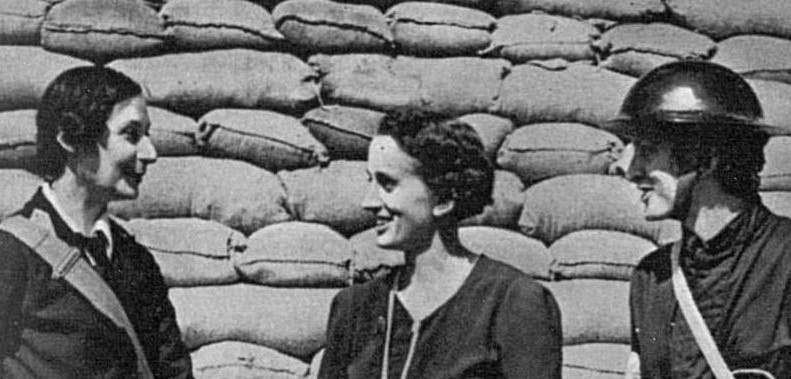
During the Second World War, women played a vital role. They kept factories running, fields harvested, cities protected, and families afloat.
When we explore the history books of the First and Second World Wars, we read about the great battles, the brave soldiers, and the pivotal moments. It's the same at school.
But behind the scenes, keeping the home fires burning, were skilled, dedicated women who stepped up to fill men's traditional shoes.
Here, we delve into the work – both paid and voluntary – undertaken by the British women of the Second World War.
Joining the war effort on the home front
Not every act of service took place on the front line. Across Britain, women volunteered in their thousands to support civilian organisations that were essential to survival.
Feeding the nation as part of the Women's Land Army (WLA)
The Women’s Land Army recruited women to work on farms, replacing agricultural labourers who had gone to fight. Known as Land Girls, they ploughed fields, milked cows and harvested crops in all weathers, ensuring the nation could feed itself during blockades and shortages.
You can explore their experiences through photographs here.
Keeping civilians safe as Air Raid Precautions wardens, Auxiliary Fire Service Volunteers and first aiders
Civil defence roles were equally vital. Women joined the Home Guard, worked in first aid units and became Air Raid Precautions (ARP) wardens. While we often imagine men patrolling bombed streets, many women stepped into these dangerous roles too.
Nineteen-year-old Sonia Straw was awarded the George Medal for her bravery in helping injured victims of an air raid in 1940. Her story reminds us that courage was not confined to the battlefield.
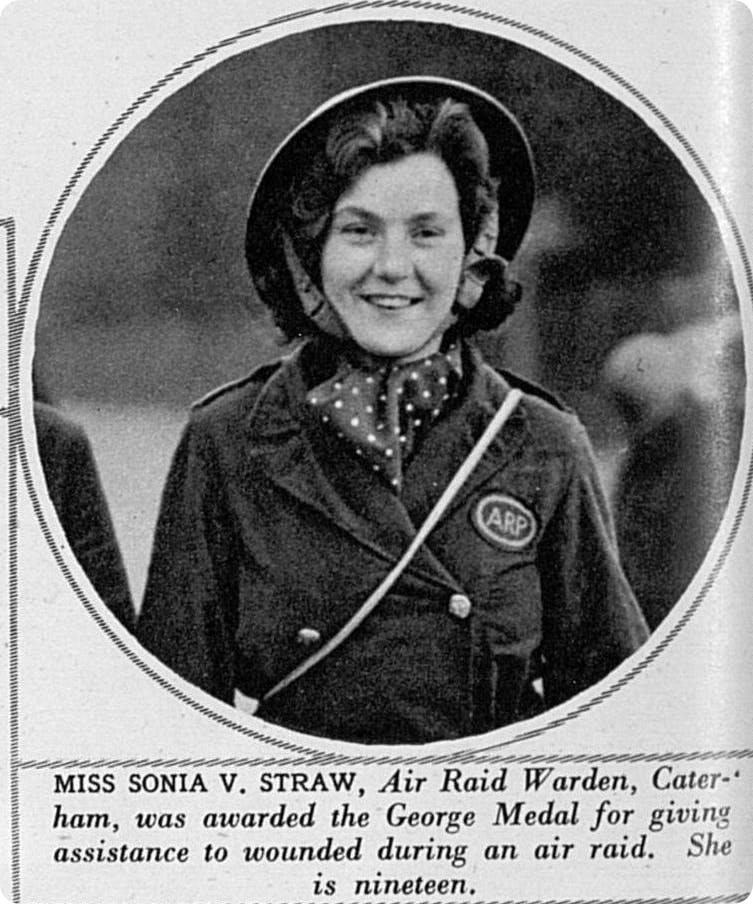
Sonia Straw in The Sketch, 9 October 1940.
For others, service was woven into daily life. Sarah Overthrow, great-grandmother of Findmypast team member Ellie Ayton, volunteered as an ARP warden while her husband Ralph worked for Cadbury by day and served with the Auxiliary Fire Service by night.
The 1939 Register captures their household on the brink of war - an ordinary family quietly preparing for extraordinary times.

Ellie’s great-grandmother in the 1939 Register. View the full record here.
During the Second World War, first aid training became commonplace. Some women went even further, driving ambulances in bombed cities.
As recounted in The Sphere, sisters Ida, Brenda and Stella Croxon all served as ambulance drivers.
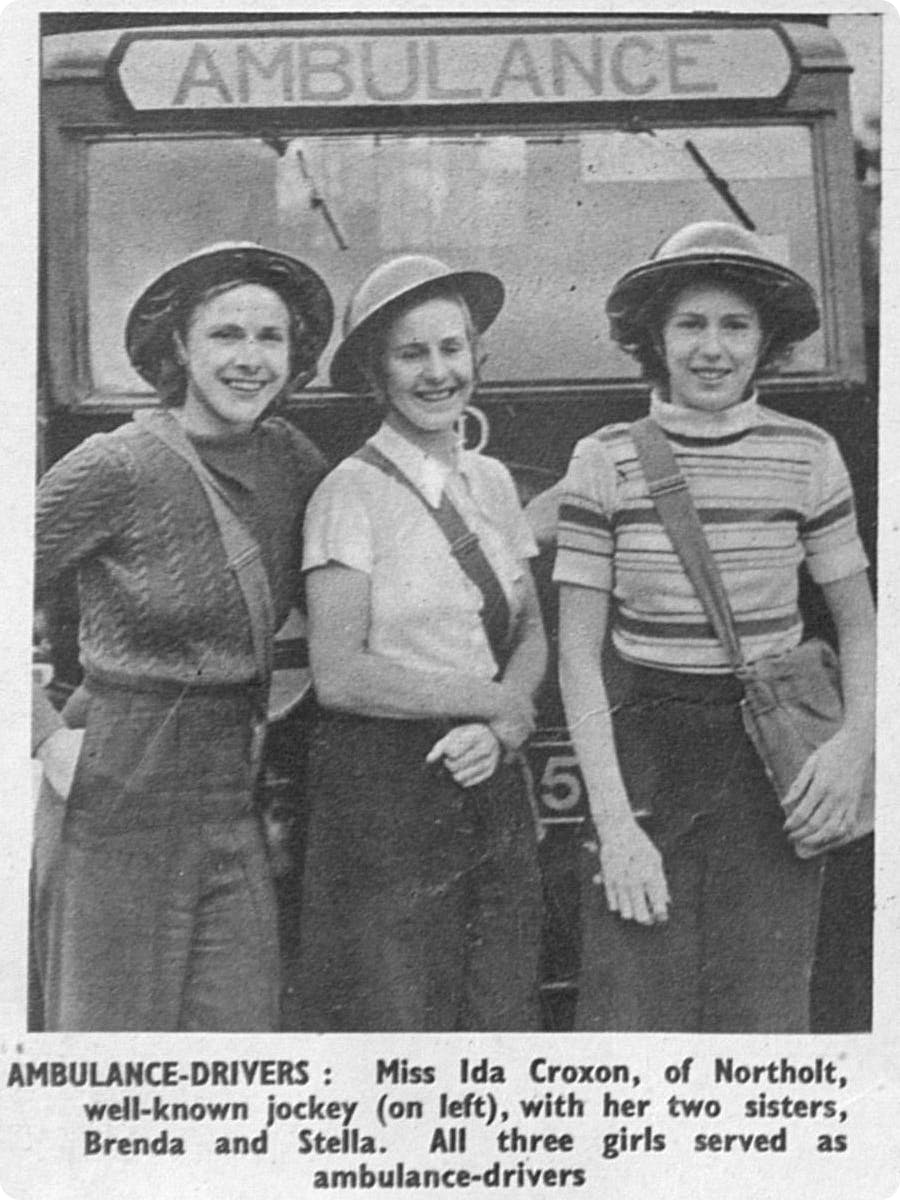
The Croxon sisters in The Sphere, 9 January 1943.
Their 1939 Register entries reveal how quickly civilian lives transformed into wartime commitment. Before the war, Ida was married, her occupation listed as 'unpaid domestic duties'. Aged 18 and 20, Stella and Brenda worked at a riding school. Within a few short years, their lives would change dramatically.
Performing National Service
The National Service Act, passed in late 1941, meant that all unmarried women between 20 and 30 must join one of the auxiliary services - The Auxiliary Territorial Service, the Women's Royal Naval Service, the Women's Auxiliary Air Force or the Women's Transport Service. While women were forbidden from taking part in battle, their responsibilities were extensive and essential.

Married women were called up in 1943, although pregnant women and mothers of young children were exempt.
The Women’s Royal Naval Service (WRNS)
Founded in 1917, disbanded after the First World War and revived in 1939, the WRNS - whose members were affectionately known as 'Wrens' - played a crucial role in both conflicts.
During the First World War, Wrens performed 'war work' as clerks, telegraphists, electricians and mechanics. Josephine Carr from Cork became the first Wren to die in service when her ship the RMS Leinster was torpedoed.
Wrens were also involved in the top-secret activities of Bletchley Park.
The Women’s Auxiliary Air Force (WAAF)
After a short-lived existence from 1918 to 1920, the WAAF was re-founded in 1939. It supported the Royal Air Force in radar operations, aircraft maintenance and communications - decisive roles during the 1940 Battle of Britain.
The Air Transport Auxiliary (ATA)
Active from 1940 until 1945, the ATA ferried aircraft between factories and airfields - 10% of its pilots were women. Nicknamed the ‘Attagirls’, the first eight women pilots under Commander Pauline Gower began their service on 1 January 1940. Sadly, 15 of them died in service, including the pioneering aviator Amy Johnson.
The Auxiliary Territorial Service (ATS)
The ATS was the women’s branch of the British Army, founded in 1938.
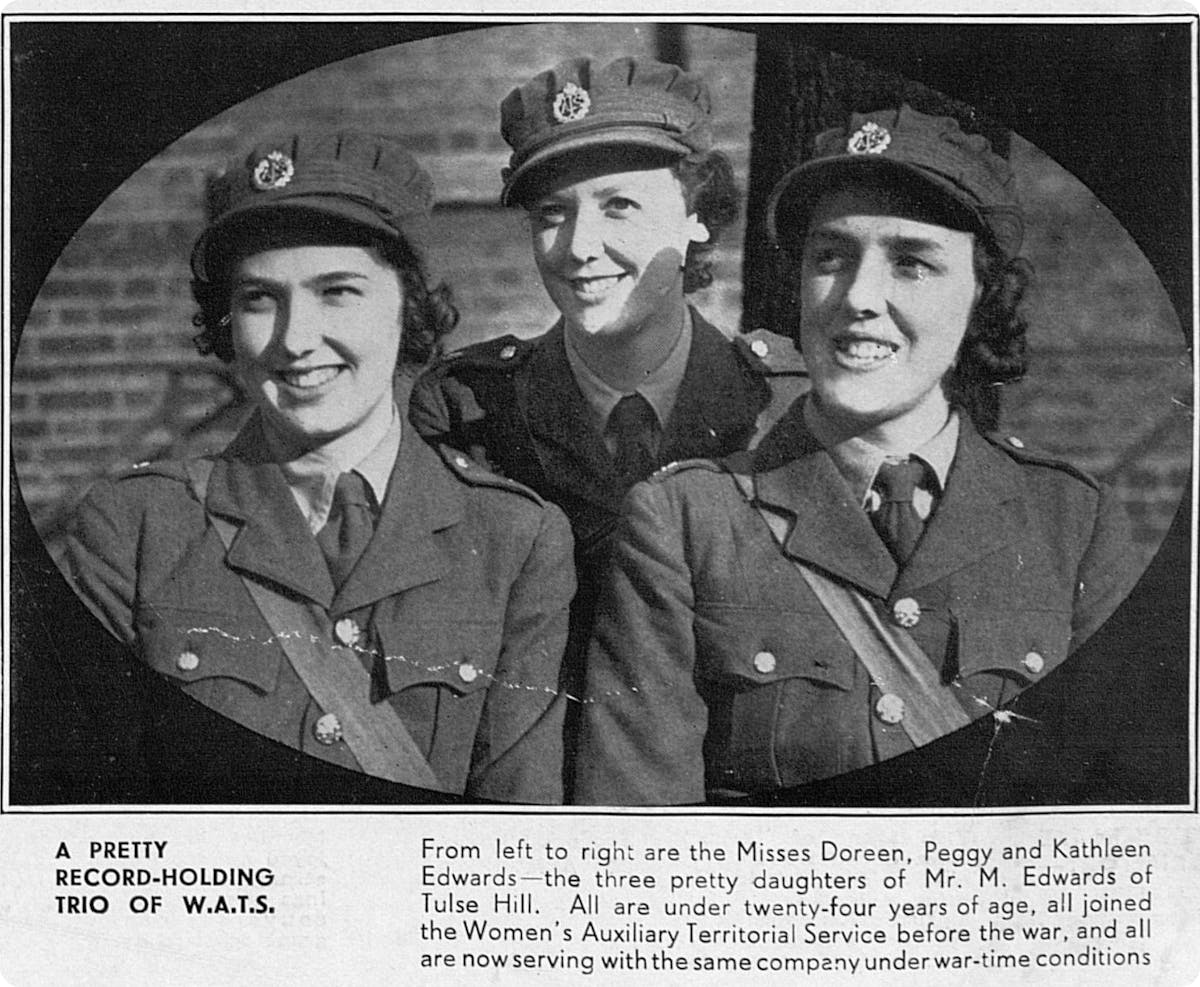
Sisters Doreen, Peggy and Kathleen Edwards of the ATS, in The Sphere, 11 November 1939.
One of its most famous members was Queen Elizabeth II, then Princess Elizabeth, who trained as a lorry driver, ambulance driver, and mechanic.
Picking up ‘men’s work’
Beyond uniformed service, women entered munitions factories, shipyards and engineering works in unprecedented numbers. They became welders, machinists and mechanics. In the face of conflict, women's employment opportunities expanded rapidly; the workplace was forever changed, as brave individuals challenged assumptions about what women could and couldn't do.
Holding families together during the Second World War
Amidst new roles and responsibilities, women continued to carry the burden of domestic labour. While men were called up to fight in ever greater numbers, women managed rationing, cared for evacuated children, supported elderly relatives and endured the absence of husbands and sons. Their commitment was constant, their resilience remarkable.
The stories of wartime women are preserved not just in medals and military records, but in newspapers, service files and the 1939 Register. Each record helps us to understand our female ancestors' experiences and delve deeper into lives defined by adaptation and determination.