Stockbrokers who marched to war: the story of the first Pals battalion
5-6 minute read
By Ellie Ayton | July 22, 2026
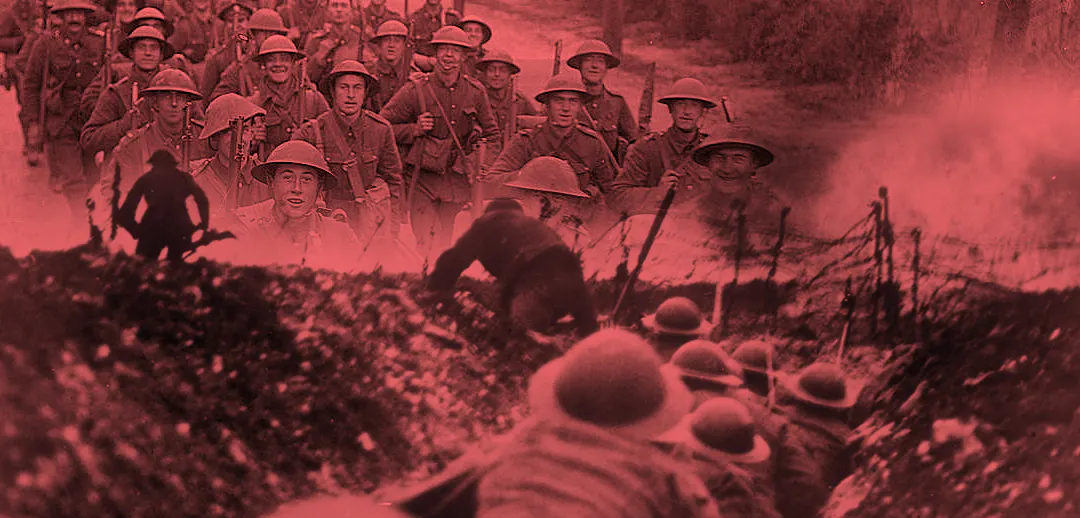
Three weeks after the First World War was declared in 1914, men who had spent their lives reading markets and managing risk chose something far less certain. They signed up together, shoulder to shoulder, not as strangers but as colleagues, friends, and neighbours who called London home.
The First World War would bind their names not to profit or loss, but to memory, and to the families still tracing their stories today.
This is the story of the very first Pals battalion – the 10th (Service) Battalion of the Royal Fusiliers, City of London Regiment.
Your country needs you
Better known as the Stockbrokers’ Battalion, the 10th Royal Fusiliers was raised in August 1914 during those first urgent weeks of the First World War when Britain called for volunteers. It was the first of the ‘Pals battalions'.
What were Pals battalions?
Pals battalions were units formed from groups of men who knew each other: colleagues, friends, even entire workplaces signing up side by side. From London to Liverpool to Leeds, the idea quickly ignited, as evidenced by the quote below from the Yorkshire Evening Post.
"Many City employees… would be willing to enlist if they were assured that they could serve with their friends."
In the case of the Stockbrokers' Battalion, the call came from within the City of London's financial community. Stockbrokers, clerks, and office workers left behind their desks, ledgers, and familiar offices to enlist together. The idea was simple and powerful: if men joined with those they trusted, recruitment would be faster and morale stronger.
The message worked. A line of 1,600 recruits snaked around the corner of Throgmorton Street in just under a week.
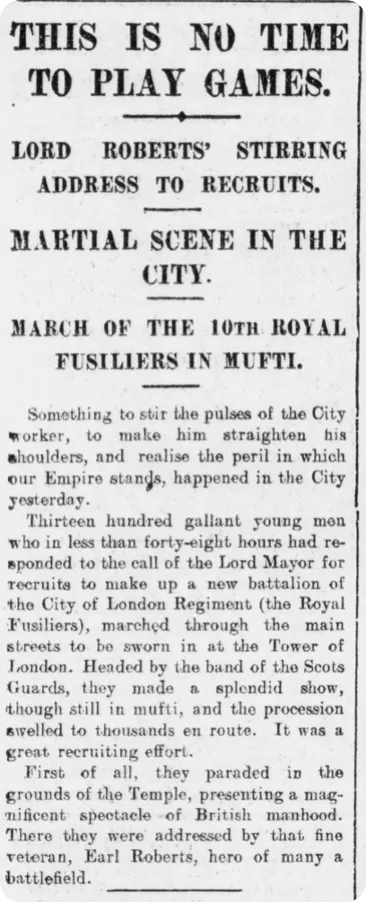
The Stockbrokers made for a stirring sight marching through the City of London, from Lloyd's Weekly Newspaper, 30 August 1914.
There was something deeply human in that decision to enlist. These were not career soldiers. They were men used to routine and a world where risk could be calculated. Joining together, they stepped into the uncertain world of warfare, with no idea of what truly awaited them.
In the months and years that followed, the example of the Stockbrokers' Battalion was repeated across the country. Friends, neighbours and colleagues were called upon to enlist together, forming volunteer battalions like the Bradford Pals, the Liverpool Pals and the Grimsby Chums.
Stockbrokers on the Western Front
Training for these green soldiers began quickly, and like many Pals battalions, it was shaped by the bonds that had existed before the war. They left behind familiar comforts for the realities of soldiering: living in close quarters, donning uniforms.
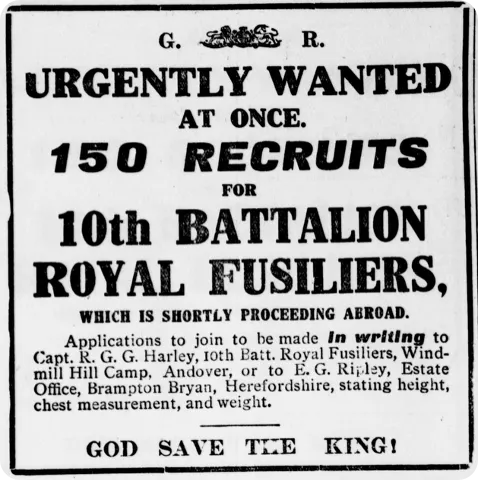
A newspaper advert from May 1915, in the Shrewsbury Chronicle.
After the training came that first step into the unknown: heading to war. The 1,100-strong battalion arrived in France in late July 1915, likely with no idea what they were to face there.
Long marches in blistering heat, meagre field rations, the booming of German guns, and the harsh, enclosed conditions of the trenches – for a contingent of office workers, this was a stark new reality.
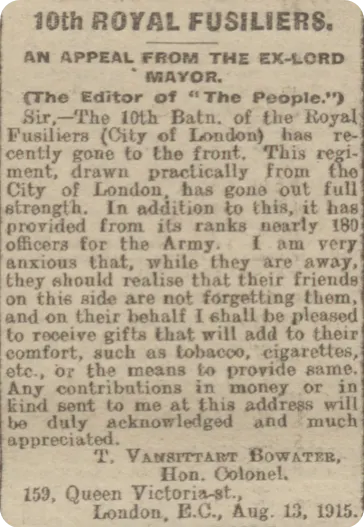
A call for contributions to home comforts for the recently departed battalion, from The People, 15 August 1915.
In early 1916, the battalion gained a new commander, Major Winston Churchill, who had resigned from government following the disastrous Dardanelles campaign.
But the later famous Churchill didn’t stay with the Stockbrokers long, moving on after only three days following a promotion.
Find your family hero
While in France, the battalion steadily lost men to the brutality of trench warfare. Artillery fire on the morning of 4 May 1916 saw 9 men killed and a further 48 wounded.
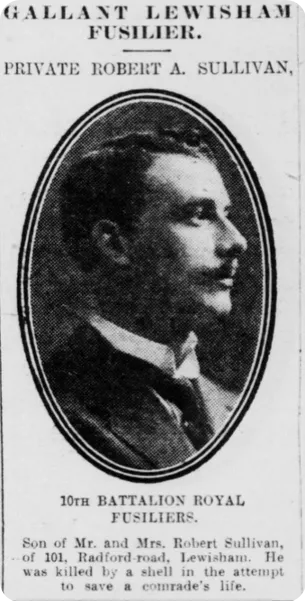
Private Robert Sullivan died trying to save a comrade’s life in 1915, pictured in the Kentish Mercury, 26 November 1915.
Their most significant and devastating engagement came during the Battle of the Somme. Like many Pals battalions across the British Army, the Stockbrokers’ Battalion was tasked with advancing against heavily defended German positions.
What happened that morning was repeated across countless regiments. Men advanced in lines, exposed to machine-gun fire that cut through entire units within minutes. For Pals battalions, the cost was felt in a uniquely concentrated way: losses didn’t just hit a military formation, they tore through offices and communities back home in a single stroke.
We can only imagine the devastation of that first day: bullets cutting through the air, shells blowing craters in the scorched earth.
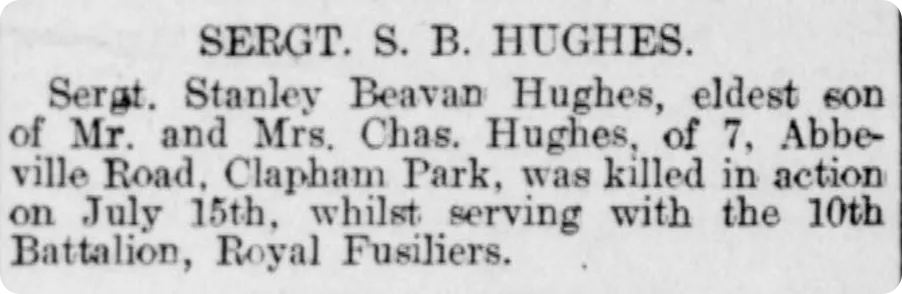
Sergeant Stanley Bevan Hughes was killed in action on 15 July 1916, from Clapham Observer, 4 August 1916.
Another loss during those first few days of the battle was Sergeant Frederick Oliver Charles Bambridge, known as ‘Nollie’, who died as a result of wounds on 13 July 1916. He was the youngest son of Edward Charles and Kathleen Silvia Bambridge – he died aged just 21. He is remembered at the Albert Communal Cemetery and on the Lloyd’s of London memorial on Leadenhall Street.
For the Stockbrokers’ Battalion, casualties were severe. The shared backgrounds that had once made enlistment feel reassuring now meant that loss travelled quickly and deeply through the same network of families and workplaces.
The battalion continued to serve after the Somme, taking part in further operations on the Western Front, but like much of the British Army, it was never quite the same unit again.
The Stockbrokers later faced more bullets and brutal warfare at Ancre, Arras, Ypres, the Spring Offensive, and during the Hundred Days Offensive. Between July 1915 and November 1918, the battalion had lost 58 commissioned officers. 688 soldiers were dead or missing.
After the First World War: disbanding and memory
After the war ended in November 1918, the Stockbrokers’ Battalion wound down soon after. Like many wartime-raised units, it was disbanded in 1919 as the army returned to peacetime footing.
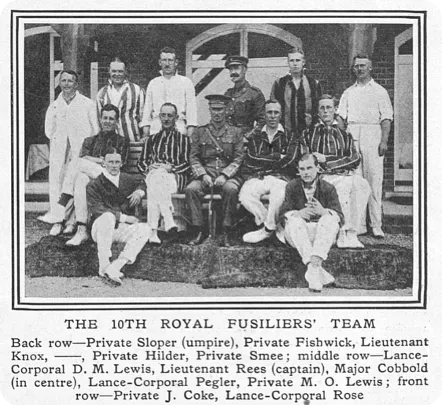
The Stockbrokers played Eton in cricket in 1915, pictured in The Tatler, 23 June 1915.
The offices and institutions these men had left did not simply reopen unchanged. Desks were empty. Entire teams were missing. The City of London continued, of course: markets resumed, businesses adapted, but the absence was there, woven into the fabric of everyday work.
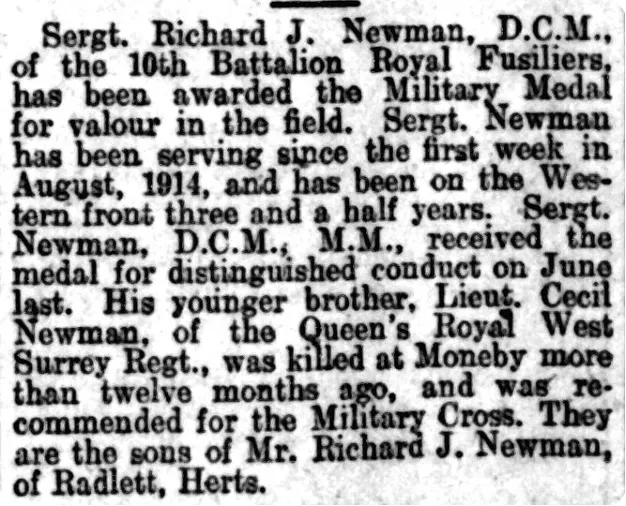
Sergeant Richard J Newman was awarded the Military Medal in 1918 – he'd been serving since the beginning of the war. From Hornsey & Finsbury Park Journal, 25 October 1918.
Memorials were raised, names recorded, plaques installed. Yet those lists, however carefully kept, only hint at the full story. Each name represented a network of people: parents, siblings, spouses, colleagues, all adjusting to a new normal shaped by loss.
If you trace your own family history, you may not find a London stockbroker who saw action at the Somme. But you will likely find a soldier ancestor: someone who enlisted with a friend, a brother who served alongside a neighbour, or a workplace that changed overnight.
Or, you might simply find a great-grandfather. One who came home to start a family, or one who left a family behind and never saw them again.
Try searching for your ancestor and discover your family’s First World War story.